|
|

|
This site is owned, designed, and operated by Kenneth A. Larson who has over a quarter century of experience in design and construction of scenery for the Entertainment Industry and Theme Parks using Computer Aided and Traditional approaches to Design. Ken also has experience in other areas of Design.
|
|
Select photographs of my many visits to The Missions of the United States South and Southwest built by Spain and Mexico between 1565 and 1823. All photographs taken by Kenneth A. Larson. All rights reserved. © 2008 - 2026. |
|
By Founding Date
| ||
|
South to North
| ||
Personal Observations |
 Mission Art & Photo-Art
|
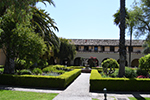
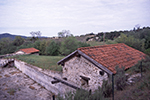
HistoryThe Chumash lived a hunter and gather existence in present day Ventura, Santa Barbara, and San Luis Obispo Counties. In their plank canoes, they traveled to the Channel Islands. They made homes from poles and interwoven reeds. They developed an astronomical system. They gathered acorns, nuts, seeds, berries, and plants and animals from the sea. They hunted a variety of animals. The Spanish arrived with the 1776 Anza Expedition. Father Pedro Font, the chaplain of the Expedition, believed the Chumash would make good converts. The Missionary Franciscan fathers wanted to establish a Mission between Santa Barara and La Purisima to fill a gap and to be a buffer against the less friendly Tulares to the northeast. Father Lasuen, who founded several Missions, sent Father Estevan Tápis of Mission Santa Barbara and Captain Felipe de Goycoechea to look for a site for a new Mission. For various reasons, it was six years before the Mission was founded on September 17, 1804, by Father Estévan Tapís. Father José Calzada and Father Romualdo Gutiérrez began construction of Mission buildings six months before the formal founding. They constructed a temporary church, a sacristy, quarters for the padres, and granary. They also began teaching the Chumash people. Five soldiers and their families and several neophytes from Santa Barbara and La Purisima also settled at the Mission. Records show that there were 112 Chumash converts of all ages that had been baptized by the end of 1804. Between 1804 and 1810, the quadrangle was completed at 350 feet per each side. The buildings had adobe walls 30 inches thick. The quadrangle included work shops such as blacksmith, potters shops, weaving and basket making, a soap factory, candle making, carpentry, and other support. Today, only one side remains. In 1810, five double houses were built for soldiers and their families along with a storehouse and guardhouse. On December 21, 1812, two earthquakes struck the Mission fifteen minutes apart. The Mission suffered damage to the church and other buildings. Repairs were made, a larger church built , a new campanile was built, and other improvements made. The new construction was dedicated on July 4 1817. The church interior was finished between 1818 to 1820. A grist mill was built in 1819 and a fulling mill in 1821 a half mile east of the Mission which overlooks the Mill site. A large storage building was built in 1823. Mexico won its independence from Spain in 1821. A revolt erupted in 1824 following a dispute between a Chumash visiting from La Purisima and a soldier. The Chumash was mistreated and the revolt spread to La Purisima and Santa Barbara. The Chumash burned the soldiers quarters who then burned the Chuimash home. A section of the church was burned and was extinguished by the Chumash. Mexican independence brought secularization to the Missions in 1834. Santa Inés Mission was secularized 1835. Mexican Franciscans replaced the Spanish Franciscans, the Mission became a parish church attending to the Chumash, the Mission lands were given to new ranchos. The new administrators mistreated the Chumash and many left leading to the decline of the Mission. In 1842, management of the Missions was transferred to the Franciscans. In 1844, the quadrangle of the old Mission was converted into Our Lady of Refuge, the first Seminary in California. Later the seminary moved a mile and a half to a new site renamed Our Lady of Guadalupe. The new site also included the first primary school for settlers’ sons and the two schools became known as La Cañada de los Pinos. The college was abandoned in 1881. In 1862, President Lincoln returned the Missions to the Catholic church. In 1904, Father Alexander Buckler began restoration of the Mission. His niece, Mamie Goulet- Abbott, began the restoration of vestments. They rebuilt some of the mission buildings including the bell-tower after it collapsed in 1911. Capuchin Franciscan Fathers began a major restoration in 1947. They added the second story to the Convento, created the museum, and began cataloging the art and artifacts. After Secularization in 1834, all that remained of the Convento was the 19th of the 22 arches which was left standing after the restoration as an example of the construction. The Capuchin Franciscans continue serving the parish. Today, the church and one side of the Quadrangle are restored and open to visitors. The Mills are accessible after a hike of about a mile, trail head is south of the parking area. The Mission is a California State Landmark and National Historic Landmark. Mission Santa Inés is an active parish church and holds regular religious services in both English and Spanish. Joseph Chapman had a colorful history. Originally from Boston, Massachusetts, he was pressed into service to an Argentine privateer. He was captured during a raid and was paroled to the supervision of Father Uria at Mission Santa Inés. He built the fulling mill. He was baptized Juan José Chapman at Mission San Buenaventura in June 1822. He married Maria Guadalupe Ortega and they moved to Los Angeles where he planted vineyards. He retired to his land grant - Rancho San Pedro, and is buried in Mission Santa Barbara cemetery. Agriculture was important to the Mission. It produced pea, squash, potato, cabbage, olive, grape, pear, apricot, hemp, peach, carrot, and other. The Mission also practiced ranching, farming, weaving, leather making for boots and saddles, and candle making. The Chumash built the aqueduct using tile pipes to bring water from the Alamo Pintado River, 1 ½ miles to the north, to the reservoir and the lavenderia. The cemetery is located behind the Mission bell-tower, north of the church. The first entry in the burial register is dated January 23, 1805. Address and DirectionsSolvang, California 93463. Phone: 805-688-4815. Mailing Address: PO Box 408 Solvang, CA 93464-0408 If traveling on Highway 101, exit at Highway 246 going east through the town of Solvang. Mission Santa Ines is on the east edge of down town Solvang and the south side of the highway. Coming from the south, take Highway 154 north, then 246 west. The mission is on the south side shortly after entering Solvang. |
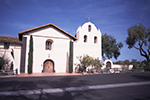
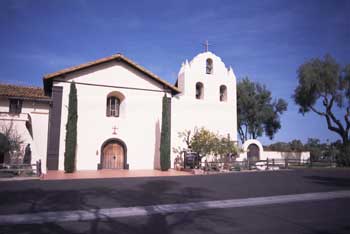 Front of church and bell tower. Photo date: 4-3-04. |
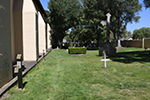
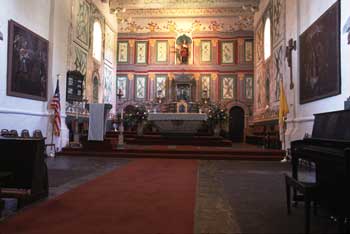 Chapel. 7-30-01. |
|
Mission
Santa Inés Main Page |
 |
 |
 |
 |
 |
 |
 |
|
By Founding Date
| ||
|
South to North
| ||

|

|

|
| Note:This is not the official site for any of the places shown in US Mission Trail. US Mission Trail is not responsible for accuracy of the information. Hours of operations, prices, and exhibits are subject to change without notice. |
|
Links |

|
This site maintained by Kenneth A. Larson. Copyright © 2004 - 2023, Kenneth A. Larson. All Rights Reserved. Website content including photographic and graphic images may not be redistributed for use on another website. |

|

|

|